
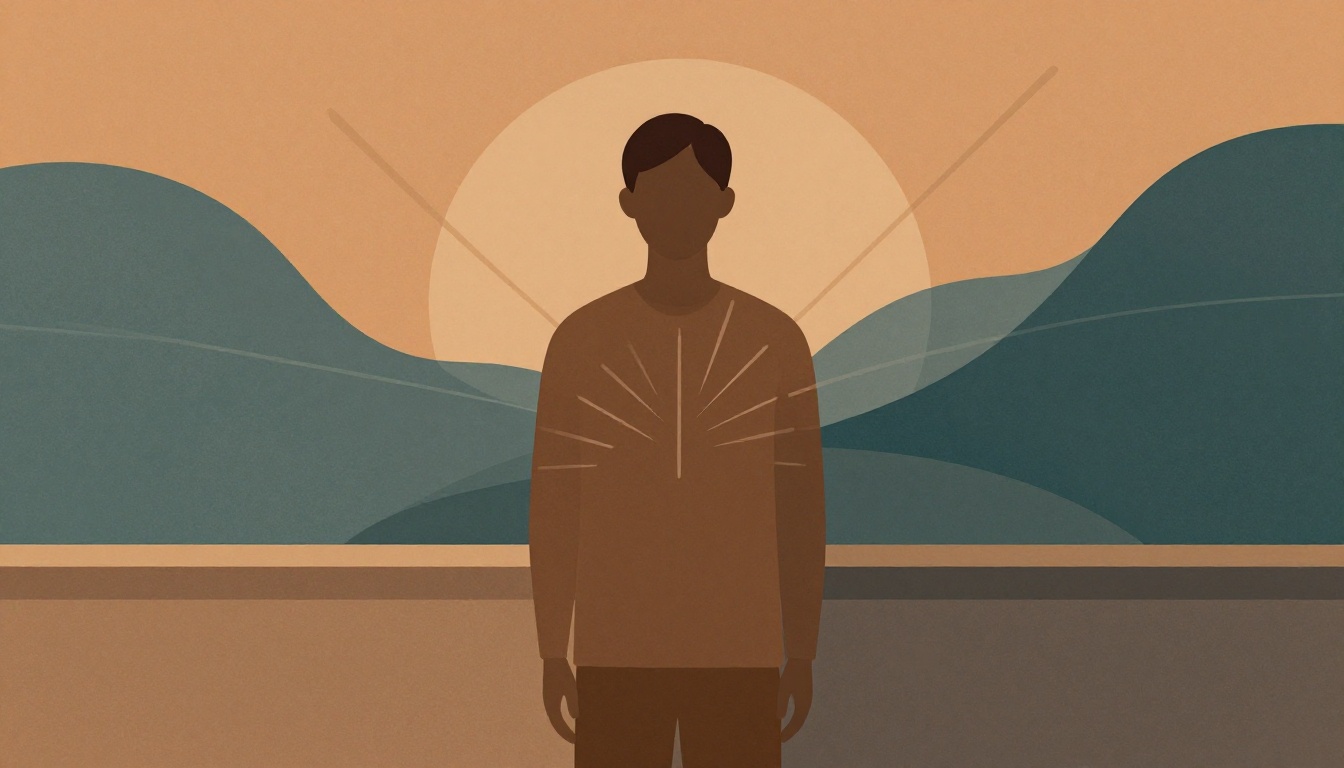
You are standing in a grocery aisle, perfectly safe. Then your heart slams against your ribs. Your palms sweat. Your chest tightens. By the time your brain asks what just happened?, your body has already responded to a threat you never consciously registered.
This is not a sign that something is wrong with you. It is a sign that your nervous system is doing exactly what it evolved to do — and doing it faster than your thinking brain can keep up.
How quickly can the amygdala trigger a threat response after sensing a potential danger cue?
Select one answer.
The Split-Second Gap Between Body and Mind
Your nervous system scans for danger using a subconscious process called neuroception, a term coined by neuroscientist Dr. Stephen Porges. Unlike conscious thought, neuroception operates below awareness, constantly evaluating sounds, facial expressions, tones of voice, and environmental cues for signs of safety or threat.
When your system detects a cue that resembles past trauma — a certain smell, a raised voice, a specific posture — it activates your survival response before your prefrontal cortex has time to analyze the situation. The amygdala, your brain's alarm center, sends a distress signal to the hypothalamus, which triggers the sympathetic nervous system. Adrenaline floods your bloodstream. Your heart rate spikes. Your breathing quickens.
All of this happens in a fraction of a second — long before your conscious mind can say, "I am safe right now."
According to Harvard Health, the wiring between the amygdala and hypothalamus is so efficient that this cascade begins even before the brain's visual centers have fully processed what is happening. That is why you can jump out of the path of a car before you consciously register that it is coming.
Why Trauma Makes This System Hypersensitive
After repeated or prolonged trauma, the nervous system does not reset to its original baseline. The amygdala becomes what researchers describe as an oversensitive smoke detector — it starts sounding the alarm at neutral stimuli that merely resemble past danger.
This is not a psychological choice. It is a neurobiological adaptation. Research from the ADAA shows that trauma changes how the brain processes threat, making the amygdala hyperreactive while reducing the prefrontal cortex's ability to regulate that response.
The result is a painful disconnect: your mind knows you are safe, but your body keeps broadcasting the opposite message.
The Window of Tolerance
Every person has a window of tolerance — an optimal zone where you can think clearly, handle stress, and stay present. Trauma narrows this window.
When something pushes you above the window, you enter hyperarousal: panic, racing thoughts, agitation. When you drop below it, you enter hypoarousal: numbness, dissociation, brain fog. Your body learns to associate certain cues with being pushed outside this window, so it preemptively activates survival mode to protect you.
What You Can Actually Do About It
Understanding the gap between body and mind is the first step. The second is learning to work with your nervous system instead of fighting it.
Name it out loud. When you notice physical activation — racing heart, shallow breath, muscle tension — say to yourself: "My nervous system is detecting a threat. This is a survival response, not a rational assessment." Labeling the sensation neutrally reduces the feedback loop that escalates panic.
Slow your exhale. The parasympathetic nervous system (your "brake") responds to slow, extended exhalations. Breathe in for four counts, out for six. This directly signals your vagus nerve that the danger has passed.
Orient to safety. Look around the room and name three objects you can see. This engages the visual cortex and helps the nervous system update its risk assessment with real-time data from the present moment.
Ground through your feet. Press your feet firmly into the floor. Notice the sensation of contact. This sends interoceptive signals upward that can interrupt the survival cascade.
Build a trigger log. Keep a simple note on your phone. Each time your body reacts before your mind understands why, jot down: the time, the physical sensation, and what was happening around you. Patterns will emerge over weeks, not days.
How the Resident Expert Can Help
You do not have to figure this out alone. Kelly Pienaar offers online counselling and coaching built around nervous system regulation and trauma recovery. Her approach is designed for people who feel stuck in survival mode — whether the source is complex trauma, narcissistic abuse, childhood experiences, or chronic overwhelm. Rather than focusing only on talk, her work helps you build practical, body-aware tools for stability and self-trust. If you are ready to move from reacting to regulating, this is a grounded place to start.