
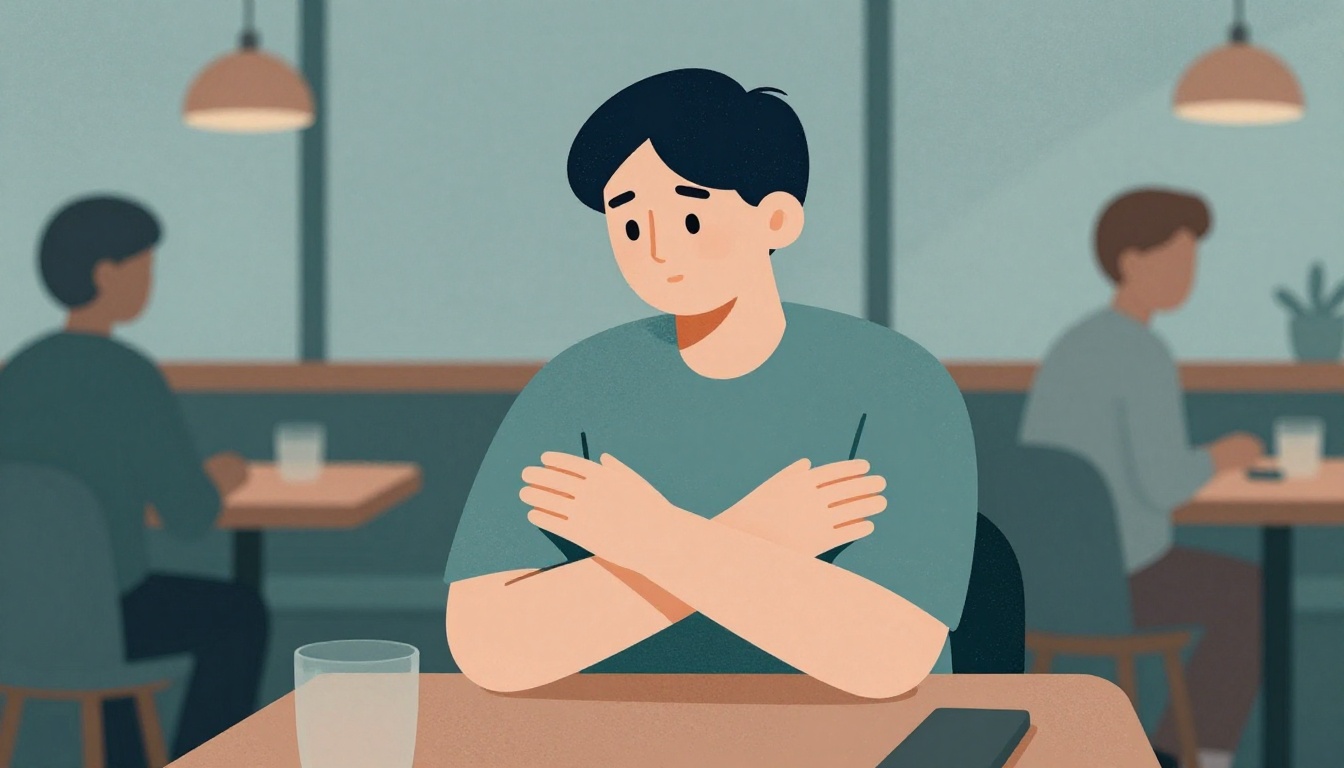
You're in a meeting, at a dinner table, or standing in a checkout line. Then it hits — a wave of heat, a racing heart, the sense that you're floating outside your body. You need to ground yourself, fast. And you cannot leave the room.
This is the real problem with trauma triggers: they rarely arrive when you're alone on a yoga mat. They show up in the middle of real life, when any visible coping strategy would draw questions you don't want to answer.
The three exercises below are designed for exactly those moments. Each one can be done with your eyes open, your hands at your sides, and zero explanation required.
What did a 2025 fMRI study reveal about the butterfly hug technique?
Select one answer.
The 5-4-3-2-1 sensory scan
This is the most widely taught grounding technique in trauma recovery — and for good reason. It works by forcing your brain to shift from threat-detection mode to sensory-input mode.
Here's how you run through it silently, without moving your lips:
- 5 things you can see. Pick five objects in your line of sight. Name them in your head. Be specific: "the crack in the ceiling," not just "ceiling."
- 4 things you can touch. Your chair arm, your own sleeve, the edge of a table. Feel the texture.
- 3 things you can hear. The hum of an AC unit. Footsteps in the hall. Your own breath.
- 2 things you can smell. Coffee. Rain. The air after someone walks past.
- 1 thing you can taste. The inside of your cheek. A sip of water. The lingering flavor of lunch.
The whole sequence takes about 60 seconds. No one around you will notice a thing. The Cleveland Clinic describes this as one of the most effective ways to interrupt a rising panic response because it reconnects you to the present through concrete sensory data.
The butterfly hug
The butterfly hug was developed within EMDR therapy as a form of bilateral stimulation — rhythmic left-right tapping that helps calm the amygdala. A 2025 fMRI study confirmed that this simple motion decreases hyperactivity in the brain's fear center while increasing activity in the prefrontal cortex, the area responsible for emotional regulation.
To do it discreetly: cross your arms over your chest so each hand rests on the opposite shoulder or upper arm. Then tap slowly — left, right, left, right — alternating about one tap per second.
In a private setting you can close your eyes. In public, keep your gaze soft and forward. The motion looks like you're folding your arms or feeling a chill. No one will read it as a coping technique. Research published through the International Psychotraumatology Institute shows that even a single session can produce measurable shifts in brain activity related to trauma processing.
The 3-3-3 rule
This is the shortest option when you have only a few seconds and need an anchor immediately.
- Name 3 things you can see.
- Name 3 sounds you can hear.
- Move 3 parts of your body — wiggle your fingers, roll your ankles, shift your weight from one foot to the other.
That's it. The movement component is what sets this apart from the 5-4-3-2-1. Physical motion sends a signal to your nervous system that you are not frozen, which helps override the immobilization response that often accompanies trauma triggers. UCLA Health notes that each step of the 3-3-3 technique helps shift focus from acute distress back to the present environment.
When to use each one
- 5-4-3-2-1 when you have a full minute and need a deep reset.
- Butterfly hug when you feel dissociated or disconnected from your body.
- 3-3-3 when you need instant relief in under 10 seconds.
All three are tools, not cures. They help you survive the moment so you can address the underlying pattern later with proper support.
How the Resident Expert Can Help
Grounding exercises are a first step, not the whole journey. If you find yourself reaching for these techniques daily, your nervous system may need deeper, more consistent support. Kelly Pienaar offers online counselling and coaching focused on nervous system regulation and trauma recovery. Her approach is body-aware, practical, and designed for people who are tired of just coping — and ready to build real stability from the inside out.